.webp)
Don't Get Stumped The Smart Way to Cut a Tree
Why Tree Cutting is a Job for Experts
Tree cutting is one of the most dangerous tasks a property owner can face. According to research, DIY tree cutting carries significant risks including property damage, personal injury, electrical shock from power lines, and even fatalities. Professional tree services generate approximately $1.5 billion in revenue annually in the U.S., and there's a good reason why—this work demands specialized training, equipment, and expertise that most homeowners simply don't have.
When searching for tree cutting help, here's what you need to know:
- DIY tree cutting is dangerous - Risks include being struck by falling branches, personal falls, electrical shock, equipment injuries, and even death
- Professional arborists are trained and insured - ISA Certified Arborists have passed rigorous knowledge tests and carry liability insurance
- Tree removal isn't always necessary - Sometimes pruning, trimming, or treatment can save a tree
- Permits may be required - Many municipalities regulate tree removal, especially for certain species or sizes
- Emergency situations demand immediate expert help - Storm damage requires 24/7 professional response
The difference between a successful tree removal and a disaster often comes down to knowledge and preparation. Professionals understand tree biology, proper cutting techniques, rigging systems, and how to protect your property throughout the process. They also know when a tree can be saved through pruning or treatment versus when removal is the only safe option.
This guide will walk you through when tree cutting becomes necessary, why attempting it yourself puts you and your property at serious risk, what to expect from professional services, and how to choose the right tree care company for your Northeast Ohio property.
When is Tree Cutting Necessary?
While trees are a vital part of our environment, sometimes tree cutting becomes a necessary decision for the safety, health, or aesthetic appeal of your property. We understand that no one wants to lose a tree, but there are critical circumstances where intervention is essential.
One of the primary reasons for tree cutting is the presence of dead or dying trees. A tree that has succumbed to disease, old age, or severe environmental stress can become a significant hazard. Similarly, diseased or pest-infested trees, if left untreated or unremoved, can spread pathogens to healthy trees on your property or even to neighboring landscapes. Early identification by a professional is crucial in these cases.
Storm-damaged trees are another common scenario. After a severe storm, trees can suffer broken limbs, split trunks, or become uprooted. These trees pose an immediate threat to people and property. In Northeast Ohio, our weather can be unpredictable, making storm damage a frequent concern.
Trees posing a risk to property are a major concern. This includes trees with significant structural defects, weak branch unions that could fail, or those growing too close to your home, garage, or other structures. We conduct thorough Hazard Tree Assessment to identify these potential dangers before they become costly problems. Additionally, sometimes trees obstruct construction projects or block desirable views, necessitating their removal. Proactive landscape management often involves strategic tree cutting to ensure the long-term health and beauty of your outdoor spaces.
Understanding the Reasons for Removal
When we evaluate a tree for removal, we look for several key indicators. Beyond obvious signs like a tree being completely dead, we also consider less apparent issues.

Structural defects are a major concern, including large cracks in the trunk or major limbs, deep cavities, or severe leans. Weak branch unions, especially those with included bark where the bark grows inward, can create points of failure where branches are likely to split. Root problems, such as girdling roots or significant decay near the base, can compromise a tree's stability and overall health. Environmental stress from factors like drought, soil compaction, or construction damage can also weaken a tree over time, making it more susceptible to disease and structural failure. Understanding when and why it's necessary to remove a tree is critical for property safety and landscape health. You can learn more about this process in our guide: Understanding Tree Removal: When and Why It's Necessary.
The Role of a Professional Assessment
Accurate assessment is the cornerstone of responsible tree cutting. Our certified arborists play a crucial role in evaluating the health and risk of your trees. They can identify species-specific risks, understanding how different trees in Northeast Ohio respond to stress, disease, and weather conditions. This expertise allows them to differentiate between a tree that can be saved through treatment or pruning and one that truly needs to be removed.
A professional assessment also covers legal considerations like permits. In many communities across Northeast Ohio, including cities like Mentor and Cleveland, there are regulations regarding tree cutting, especially for larger trees or those in specific zones. We can help you navigate these local requirements and determine if you need a permit to remove a tree on your property: Do I Need Permit to Remove Tree?. An ISA Certified Arborist, like those on our team in Cleveland, Ohio, has deep knowledge in the art and science of tree care for diagnosing and treating your trees, ensuring decisions are made with the tree's long-term health and safety in mind. You can find more about certified arborists here: Certified Arborist Cleveland Ohio.
The Dangers of DIY vs. The Safety of Professional Tree Cutting
We often hear stories, sometimes even humorous ones, about homeowners attempting tree cutting themselves. But the reality is, it's no laughing matter. The risks associated with DIY tree cutting are profound, often leading to severe property damage, serious personal injury, or worse.
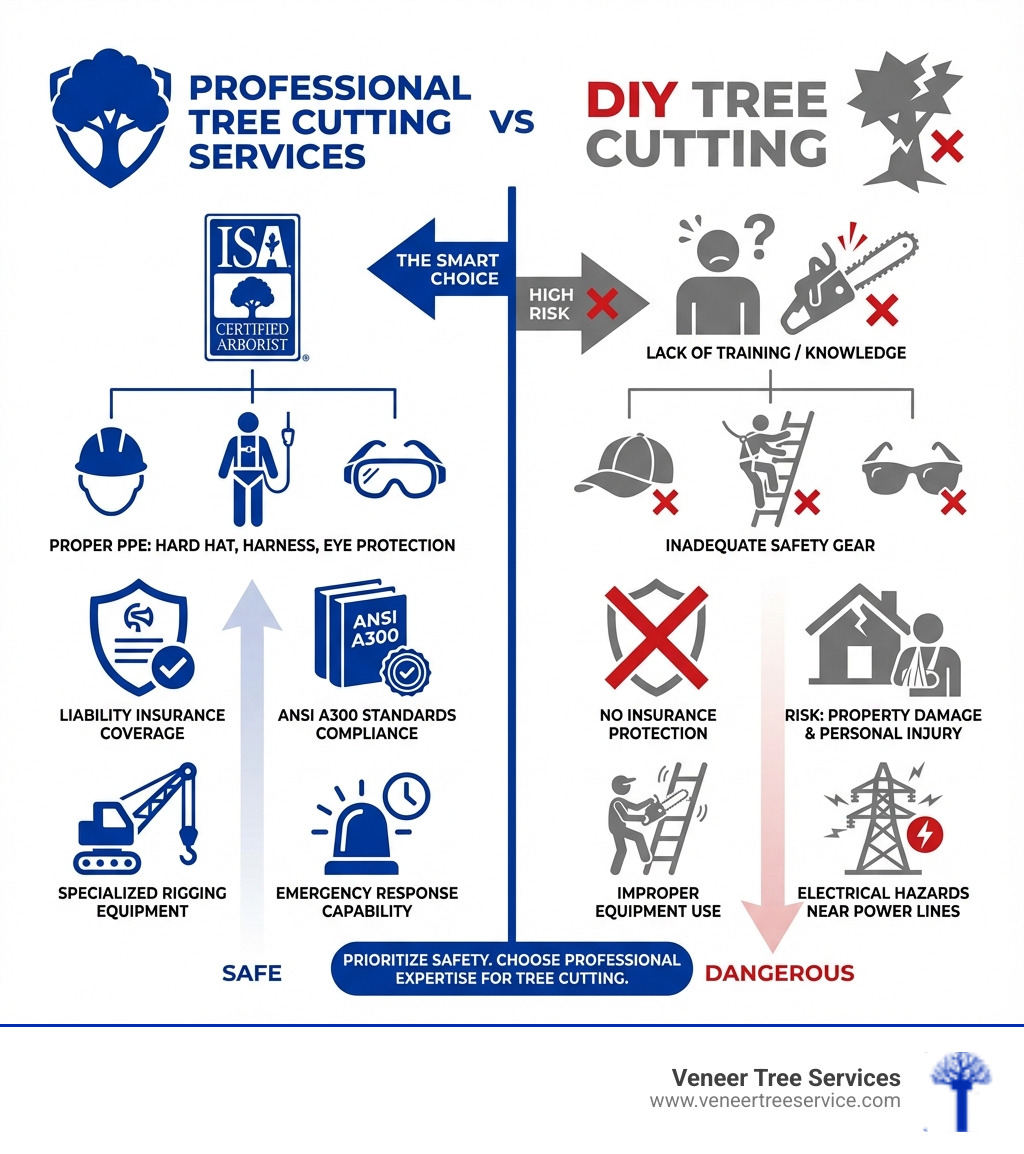
Imagine trying to cut down a large tree with a chainsaw, only for it to fall in an unintended direction, crashing into your home or a neighbor's fence. Property damage risks are high due to a lack of experience in directional felling and rigging. Personal injury statistics for DIY tree work are alarming, including risks of being struck by falling branches, suffering falls from ladders or trees, or injuries from improper equipment use. Electrical hazards are a silent killer; branches near power lines can become energized, leading to severe shocks or electrocution if not handled by trained professionals. The lack of proper safety gear and training, combined with no liability insurance to cover accidents, makes DIY tree cutting a gamble no homeowner should take. We explore these risks in more detail in our article: DIY vs. Professional Tree Cutting Services: Pros and Cons.
Why Professionals are the Safer Choice
Choosing professionals for tree cutting isn't just a convenience; it's an investment in safety and peace of mind. Our team includes ISA Certified Arborists, meaning they have passed rigorous knowledge tests and demonstrate a commitment to providing the best tree services. You can search for a certified arborist through resources like Find a certified arborist.

Professionals come equipped with proper safety gear (PPE), including hard hats, eye protection, ear protection, specialized gloves, and harnesses for working at heights. They use advanced rigging techniques to safely lower branches and control the direction of falling trees, protecting your property and surrounding landscape. Crucially, professional services carry comprehensive liability and workers' compensation insurance, protecting you from financial responsibility should an accident occur on your property. We also adhere to industry standards like ANSI A300, ensuring all work is performed safely and correctly.
Emergency Situations Demand Experts
When disaster strikes, such as a major storm in Northeast Ohio, the need for expert tree cutting becomes urgent. Emergency situations, like a tree falling on your house or blocking a driveway, require immediate, professional response. Our team offers 24/7 availability for storm damage response, understanding that these situations can't wait.
We employ specialized equipment for hazardous removals, including cranes and heavy-duty chippers, to efficiently and safely clear debris. Our priority is preventing further damage to your property and ensuring the safety of your family. You can find essential information on how we handle these critical events in our Emergency Tree Removal Guide and learn more about our Emergency Storm Cleanup services.
What to Expect from a Professional Tree Service
When you engage a professional tree cutting service, you're not just hiring someone to chop down a tree; you're investing in a structured, safe, and efficient process designed to protect your property and deliver exceptional results. We pride ourselves on a transparent and thorough approach, from your initial inquiry to the final cleanup.
The professional process typically begins with a detailed consultation and estimate. During this phase, our certified arborists will visit your Northeast Ohio property to assess the tree(s) in question, discuss your needs, and identify any potential hazards. This allows us to provide you with an accurate and comprehensive quote. Getting multiple, detailed Tree Service Quotes is always a good practice.
Once the scope of work is agreed upon, we move to site preparation. This involves establishing safety zones, protecting surrounding landscaping or structures, and deploying all necessary equipment. The tree cutting process itself is then executed with precision, using the appropriate techniques for the specific situation. Finally, we handle complete debris removal and cleanup, leaving your property tidy and safe.
The Professional Process of Tree Cutting
The actual tree cutting process can vary significantly depending on the tree's size, location, and condition. Our experts are trained in various techniques to ensure safety and efficiency.
For smaller or easily accessible trees, felling techniques might be used, where the tree is cut at its base and carefully directed to fall in a predetermined open area. For trees in confined spaces or those posing high risks, climbing and rigging are often employed. Arborists ascend the tree, removing branches in sections and lowering them safely to the ground using ropes and pulleys. In situations involving very large or hazardous trees, crane-assisted removal allows for the safe lifting and removal of entire sections, minimizing impact on the surrounding area. For more complex removals, sectional dismantling ensures that the tree is taken down piece by piece. Our Professional Tree Removal Service ensures that the most appropriate and safest method is always chosen for your unique situation.
Factors That Influence Cost
The cost of professional tree cutting services isn't a one-size-fits-all figure. Several factors come into play, which is why an on-site assessment is crucial for an accurate estimate.
The tree's size and height are often the most significant determinants; larger trees require more time, equipment, and personnel. Its location and accessibility also matter; a tree in an open yard is less complex to remove than one nestled between a house and power lines. The tree's condition and risk level—for example, if it's dead, diseased, or leaning precariously—can increase the complexity and, consequently, the cost. The specialized equipment needed, such as cranes or advanced rigging, will also impact the price. Finally, cleanup requirements, including hauling away debris or stump grinding, are factored into the overall cost. For more detailed insights into pricing, refer to our Tree Removal Service Cost guide.
| Factor | Small Tree (e.g., 20 ft) | Medium Tree (e.g., 40 ft) | Large Tree (e.g., 60+ ft) |
|---|---|---|---|
| Size & Height | Lower | Moderate | Higher |
| Location/Access | Easy access = Lower | Moderate access = Moderate | Difficult access = Higher |
| Condition/Risk | Healthy = Lower | Diseased/Leaning = Moderate | Hazardous/Dead = Higher |
| Equipment Needed | Basic tools | Standard equipment | Specialized (crane, etc.) |
| Cleanup | Basic debris removal | Full debris removal | Stump grinding/removal |
Beyond Removal: A Look at Different Tree Services
While tree cutting often implies complete removal, our arborists offer a spectrum of services designed to maintain the health, safety, and beauty of your landscape. Sometimes, a tree doesn't need to be cut down entirely; it just needs a little professional care.
Pruning for health and structure is a common and beneficial service. Proper pruning improves a tree's structural strength, maintains its health, and improves its beauty. It involves removing dead, diseased, or hazardous branches, which can significantly extend a tree's life and reduce risks. Trimming for aesthetics and clearance focuses on shaping trees, improving their appearance, and ensuring they don't interfere with structures, power lines, or pathways.
After a tree has been removed, you might be left with a stump. We offer both stump grinding and removal services. Stump grinding is often preferred as it's less intrusive, grinding the stump down below ground level and converting it into wood chips. Stump removal involves completely uprooting the stump and its roots, leaving a clean slate but requiring more invasive work. For larger projects, we also provide lot and land clearing services, preparing your property for new construction or landscaping endeavors. Our Tree and Brush Clearing services are comprehensive.
Best Practices for Different Types of Tree Cutting
Different types of tree cutting require specific best practices to ensure the tree's health and your property's safety. Our certified arborists are experts in these techniques.
- Crown thinning involves the selective removal of branches to increase light penetration and air movement throughout the tree's canopy. This helps reduce wind resistance, minimizing the risk of storm damage, and promotes healthier growth by allowing more sunlight to reach inner branches.
- Crown raising is the practice of removing lower branches to provide clearance for pedestrians, vehicles, or structures. It's often used to create a clear stem or improve visibility.
- Crown reduction pruning is a method used when a tree has grown too large for its space. Unlike harmful "topping," crown reduction carefully shortens limbs back to smaller lateral branches, preserving the tree's natural shape and minimizing stress. This is preferable to topping, which can cause severe damage and lead to weak, rapid regrowth.
Understanding these pruning techniques is crucial for maintaining tree health. You can learn more about our professional approach in our guide to Tree Pruning Services.
When is the appropriate time for tree cutting and pruning? For tree removal, any time of year is generally acceptable. However, for pruning, the dormant season (late winter or early spring before bud break) is often best for many deciduous species. This minimizes stress on the tree, reduces the risk of disease transmission, and allows for easier visualization of the tree's structure. Some flowering trees, however, are best pruned immediately after they bloom to avoid cutting off the next season's flowers. Our arborists consider the specific tree species, its health, and the desired outcome to determine the optimal timing for any tree cutting work on your Northeast Ohio property.
Frequently Asked Questions about Tree Cutting
We know you have questions, and we're here to provide clear, expert answers to help you make informed decisions about your tree care needs.
How much does professional tree cutting cost?
The cost of professional tree cutting services varies significantly based on several factors, including the tree's size and height, its location and accessibility on your property, the tree's condition and risk level, and the specific equipment needed for the job (e.g., crane, specialized rigging). A small, easily accessible tree might cost a few hundred dollars, while a large, hazardous tree in a difficult-to-reach spot could cost several thousand. To get an accurate estimate custom to your specific situation, we always recommend obtaining a detailed, written estimate from a qualified arborist.
When is the best time of year to cut a tree?
For complete tree removal, any time of year is generally acceptable, though conditions like frozen ground might make some tasks easier or harder. However, for pruning and trimming services, the dormant season (typically late fall or winter in Northeast Ohio, before new buds emerge) is often considered the best time for many deciduous species. Pruning during dormancy minimizes stress on the tree, reduces the risk of disease transmission, and allows arborists to clearly see the tree's structure. For flowering trees, the timing depends on when they bloom; usually, pruning after flowering is recommended to ensure you don't remove the current year's blooms. Our arborists will assess your specific trees and recommend the optimal time for any tree cutting or pruning.
Do I need a permit to cut down a tree on my property?
It absolutely depends on your specific location within Northeast Ohio. Many cities and municipalities, such as Mentor, Cleveland, and others in Cuyahoga, Geauga, Lake, and Lorain counties, have regulations concerning tree cutting and removal. These regulations often apply to trees of a certain size, specific species, or those located in particular areas (e.g., within a certain distance of the street, in a designated conservation area, or part of a protected landscape). Failure to obtain a required permit can result in fines. We can help you understand and navigate the local permit requirements for your property.
Conclusion
We hope this guide has shed light on the complexities and critical importance of professional tree cutting. From understanding when removal is truly necessary to recognizing the profound dangers of DIY attempts, it's clear that this is a job best left to the experts. The long-term health of your landscape, the safety of your property, and the well-being of your family depend on it.
Choosing a professional service, like Veneer Tree Services, means you're partnering with ISA Certified Arborists who bring expertise, proper equipment, comprehensive insurance, and a deep understanding of tree biology to every project. We've been serving over 12,000 customers in Northeast Ohio since 1986, providing prompt, professional, and safe tree removal, stump grinding, and lot clearing services in communities like Chagrin Falls, Gates Mills, Mayfield, Newbury, Chesterland, Willoughby, Waite Hill, Mentor, Avon, North Ridgeville, Shaker Heights, Hudson, Aurora, and across Cuyahoga, Geauga, Lake, and Lorain counties.
For expert and safe tree services in Northeast Ohio, trust the certified arborists at Veneer Tree Services. We're here to help you make the smart choice for your trees and your peace of mind.
Contact us for a free consultation on our expert tree services


.png)
.png)